The Dragons of Mount Pilatus: Legends Behind the Name
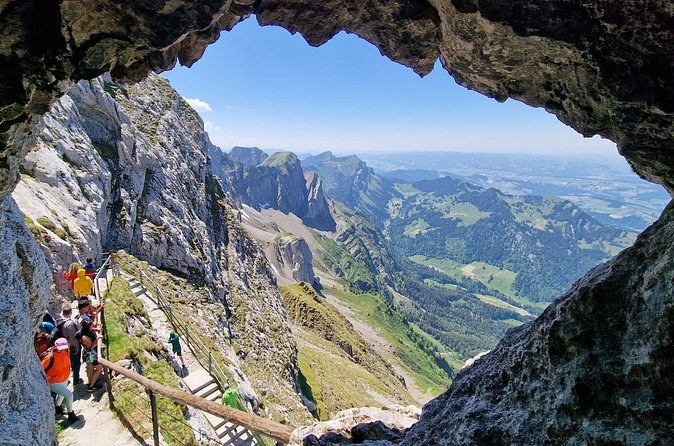
The short answer. For centuries Lucerne feared the mountain. Legend put the ghost of Pontius Pilate in a lake near the top, raising storms if disturbed, and the city banned the climb until the 16th century. Dragons were said to live in its crevices, and a stone a dragon is said to have dropped in 1420 was used as a cure for a century. You meet the legends today on the Dragon Path and in Dragon World at the summit, both free.
Stand on the terrace on a clear day and Pilatus looks like your friendly local mountain. For most of its history it was the opposite: the place storms came from, where floods rolled down on the town and something nameless lived in the rock. The legends are not decoration added for you, the visitor. They explain why nobody from Lucerne climbed it for centuries, and why you ride up in a railcar with a dragon on its side. The dates below are history; everything else is legend, and it is told as legend.
| The legend | What it says | Where you meet it |
|---|---|---|
| The governor in the lake | Pilate's body lies in a mountain lake and raises storms if disturbed | The mountain's name |
| The healing dragons | Dragons with healing powers live in the bare crevices | The path through the rock at the top |
| The dragon stone | A dragon flying to the mountain dropped a stone that cured the sick | The Natur-Museum Luzern |
| The good mountain people | Small folk who protect the chamois and punish the cruel | Lucerne's old tales |
A mountain with two names
In the Middle Ages the massif was not called Pilatus at all. The oldest record, from about 1100, calls it fractus mons, the broken mountain, later Frakmont; the name survives in Fräkmüntegg, the middle station of the gondolas. Pilatus appears in the 15th century, and nobody agrees where it came from. One explanation is the Latin pileatus, cloud-capped, because the summit so often wears a cap of cloud. Another reads it as a mountain set with rock pillars. Legend preferred a darker answer.
The governor in the lake
The best-known story holds that Pontius Pilate, the Roman governor who condemned Jesus, was buried on the mountain. Wherever his body was laid, violent storms broke out, so it was carried to a peak where storms raged anyway and sunk in a small lake near the Oberalp. There, the story goes, he rises every Good Friday in his robes of office to sit in judgement. Throw a stone into the water and the ghost would answer with storms and floods that ran down as far as Kriens.
Lucerne took this seriously. Until the 16th century the city council forbade anyone to climb the mountain, on pain of punishment. In 1387, six clergymen may have been given long prison terms for planning to go up without permission. A similar legend is told of Monte Vettore in Italy, which suggests the story travelled. The lake itself has since silted up.
The first recorded climbs
- 1518: Vadian's party goes up with the council's leave and leaves the lake in peace, then climbs to a high point on the ridge.
- 20 August 1555: the Zurich naturalist Conrad Gessner climbs the mountain and writes it up the same year as a description of the "broken mountain" or mountain of Pilate.
- 1856: the Klimsenhaus, the first building for tourists, opens on the mountain.
- 1889: the cogwheel railway opens, and anyone can ride to the top.
Gessner climbed mountains, he wrote, for exercise and for the pleasure of the view. Later visitors included the philosopher Arthur Schopenhauer in 1804 and Julia Ward Howe in 1867. Queen Victoria came too: Restaurant Pilatus-Kulm's grand hall is named after her, and the restaurant dates her visit to around twenty years before the hotel opened in 1890. The railway that brought everyone else is told in the story of the cogwheel railway.
The dragons in the rock
Local legend filled the mountain with more than one ghost. It was the home of dragons and serpents, witches and sorcerers, and also of small, kindly mountain people who protected the chamois and punished anyone hard-hearted. In the Middle Ages, Pilatus-Bahnen notes, people believed healing dragons lived in the bare crevices of the summit rock.
The dragon stone of 1420
The one legend you can still see in a museum case began in the summer of 1420, at Rothenburg north of Lucerne. A farmer named Stämpfli, the tradition says, watched a fiery dragon fly towards Pilatus and drop something: a ball wrapped in clotted blood. Some retellings give the year as 1421. The ball became a healing stone, pressed on the sick for all manner of illness. In 1523 a Lucerne surgeon who had bought it had the city's mayor and council certify its powers in writing.
After his death belief faded, but the stone stayed a treasured curiosity, handed from family to family. The canton of Lucerne bought it in 1929 for 400 francs. In 1954 it was lent to a museum in Basel without paperwork and forgotten. A curator on a school trip spotted it in a display case there in 1960, and it came home to the Natur-Museum Luzern only in 1978, where you can see it today. A CT scan in 2006 settled the old meteorite theory: it is a solid painted ball of a single material, probably clay, about the size of an apple.
Where to meet the dragons at the summit
The legends have moved into the rock itself. The Dragon Path is a circular walk of about 20 minutes. You start at the end of the Panorama Gallery and walk through the cliffs, past windows cut into the stone; parts of it can be closed in winter. Dragon World, next to it, tells the stories with interactive displays, takes about 20 minutes and costs nothing. If you want the stories in your pocket, ask at the hotel reception or at the Kriens valley station for the free booklet of legends. Both are on the things to do at the top page, with the rest of the summit.
The weather maker
Behind the ghost stories sits something real. Pilatus stands alone at the edge of the Alps, so cloud gathers on it first. Its streams sent floods towards Lucerne for centuries, until they were tamed in the 18th century. The mountain became Lucerne's weather prophet, and an old local rhyme reads the long banner of cloud on its summit as a forecast. MeteoSwiss keeps a station on the Oberhaupt at 2,105 metres; the weather by month uses its figures.
Where these facts come from
- Pilatus-Bahnen: the Dragon Path
- Pilatus-Bahnen: Dragon World
- Pilatus-Bahnen: Restaurant Pilatus-Kulm opening hours
- Wikipedia (German): Pilatus (Bergmassiv), history, legends and wildlife
- Wikipedia (German): Luzerner Drachenstein, the dragon stone in the Natur-Museum Luzern
- Wikipedia: Pilatus (mountain)
- Wikipedia: Conrad Gessner
Tours with a guide to tell the stories
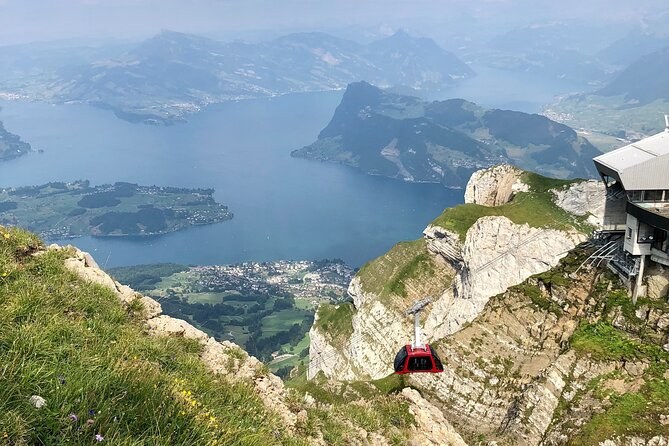
Mt. Pilatus Peak and Lake Lucerne Cruise Small Group from Lucerne
Up to 15 people with a local guide, from Platform 7 at Lucerne station. You get about an hour at Fräkmüntegg and two on the summit, then the cogwheel and the boat.
From $271 per person
Check Availability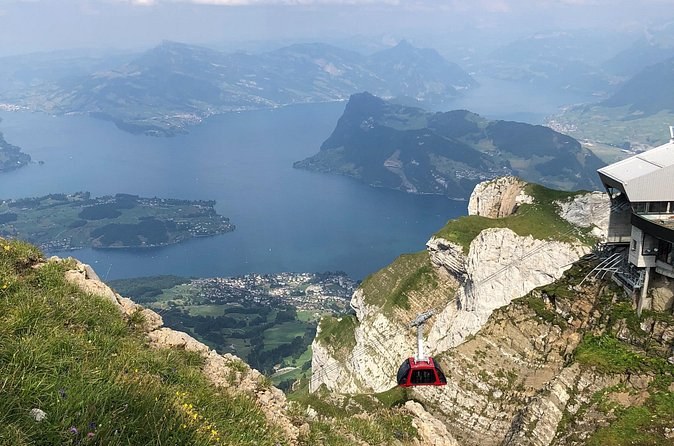
Mt. Pilatus & Lake Lucerne Cruise Private Tour | From Lucerne
A private guide meets you at your Lucerne hotel for the loop, first-class on the lake, and about three and a half hours on the mountain. For up to 7.
From $693 per person
Check Availability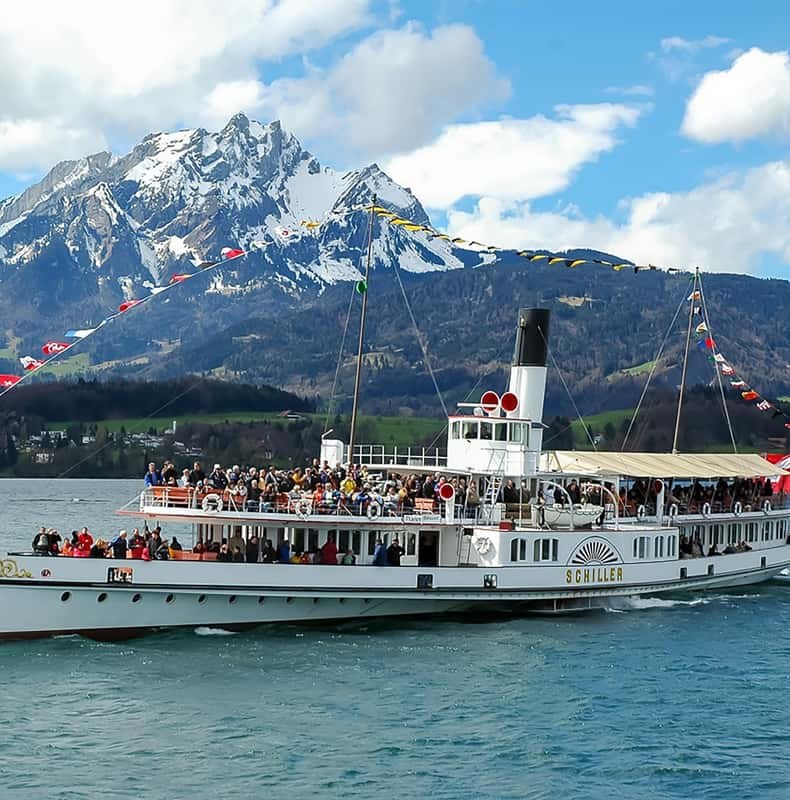
From Zurich: Lucerne & Mount Pilatus Day Tour
Ten hours from Zurich with a guide in English or Spanish: an hour in Lucerne, cableway up, cogwheel down and the boat. A lunch voucher replaces the boat after 18 October 2026.
From $207 per person
Check AvailabilityNext: go looking for the dragons on foot with Mount Pilatus hikes. Every guided day, private day and railway ticket up the mountain sits side by side on Mount Pilatus Tours.