Mount Pilatus Facts: 12 Things Most Visitors Miss
The short answer. The lifts stop at Pilatus Kulm, but the highest point is the Tomlishorn, a walk away. The cableway ride takes under four minutes, 132 gondola cabins run below it, the railway once ran on steam and still uses its original rack, and the famous dragon stone turns out to be painted clay. Here are twelve facts that change how you see the mountain.
Pilatus is so close to Lucerne that you may treat it as a view from the lakefront, then ride up for an afternoon. A lot hides in plain sight: in the name, in the rock under the railway, in the fog below the summit in autumn. You do not need a guide to find any of these, but each one makes your trip more interesting. If you would like the full story told on the spot, the guided days do that.
| Fact | The number |
|---|---|
| Highest peak | Tomlishorn, about 2,128 m |
| Cogwheel gradient | 48% at the steepest |
| Cableway ride | 3 min 39 s |
| Gondola cabins | 132, four seats each |
| Railway opened | 4 June 1889 |
| Dragon stone | Painted clay, apple-sized |
1. The lifts do not stop at the highest point
Pilatus is a ridge of peaks, not a single top. The station sits between the Esel and the Oberhaupt; the highest point is the Tomlishorn, about 2,128 metres, some 1.3 km to the southeast. The flower trail there and back takes about an hour and a half in summer, and Mount Pilatus hikes times every route.
2. It is the steepest cogwheel railway in the world
The line from Alpnachstad climbs at up to 48 per cent, almost twice the 25 per cent the first plan for the mountain could reach with a conventional rack. Eduard Locher's double rack, gripped by horizontal cogwheels, made that possible in 1889, and nothing has beaten it since.
3. It still runs on its first rails
The rack rails laid in the 1880s are still in use. When the teeth wear, the rails are turned over to give a fresh face. Because of the rack there are no ordinary points on the line, only turntables and traversers.
4. It was built without a penny of public money
About 600 labourers, most of them Italian, built the railway over three summers from 1886. The government gave no subsidy; the company raised the money itself and the line has paid its way ever since.
5. Two of its steam cars survive in museums
Before 1937 your ride up would have taken 70 to 80 minutes by steam. One of the steam railcars is at the Swiss Museum of Transport in Lucerne and another at the Deutsches Museum in Munich. Today's railcars, eight of them with 46 seats each, date from 2023.
6. The cableway ride takes less than four minutes
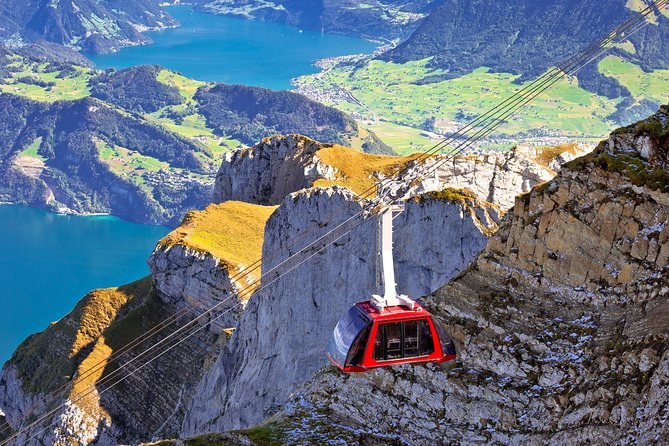
The Dragon Ride from Fräkmüntegg covers 1,387.6 metres and climbs about 647 in 3 minutes 39 seconds. It opened on 9 March 1956 and was rebuilt in 1983 and again in 2015; its two cabins each carry 55 passengers and a driver.
7. 132 small cabins do the long part
Below the cableway, the panorama gondolas from Kriens have run since Christmas Eve 1954: 132 four-seat cabins, at least 18 minutes to Fräkmüntegg. You can get off at Krienseregg and walk. The Golden Round Trip strings them together with the cogwheel and the boat; the loop explains which way round to ride it.
8. The name probably has nothing to do with Pilate
The oldest name, from about 1100, is fractus mons, the broken mountain; it survives in Fräkmüntegg. "Pilatus" appears later, perhaps from the Latin for cloud-capped. The story that Pontius Pilate lies in a lake near the top came after the name, and a similar tale is told of Monte Vettore in Italy. The dragons of Mount Pilatus tells the rest.
9. Lucerne once banned the climb
Until the 16th century the city council forbade climbing the mountain, for fear of waking the ghost and its storms. The naturalist Conrad Gessner climbed it on 20 August 1555 and published an account the same year.
10. The dragon stone is painted clay
Tradition says a dragon dropped a healing stone near Rothenburg in 1420, and you can see it in Lucerne. The city certified its powers in 1523, and it sits today in the Natur-Museum Luzern. A CT scan in 2006 found a solid painted ball, probably clay, with nothing inside.
11. The summit is often sunny when Lucerne is grey
In autumn and winter, fog often lies over the lowlands while the summit sits above it in the sun. MeteoSwiss's station on the Oberhaupt records 103 hours of sunshine in an average December, against 39 in Lucerne. It is colder, though: about 9.5 °C in July at the summit, against 19.4 °C in town. The weather by month page has every month.
12. In 2026 the mountain has three closing dates
The boat to Alpnachstad stops after 18 October. The gondolas and cableway from Kriens close for their overhaul from 19 October to 27 November. The cogwheel runs until 29 November and not again until the spring. If you travel between those dates you cannot ride the loop, and the guided days change their route.
Where to see these for yourself
- The rack and the gradient: ride the cogwheel down and look back up the line.
- The highest peak: the flower trail from the station, June to October.
- The dragons: the path through the rock and the free Dragon World at the top.
- The steam cars: the Swiss Museum of Transport in Lucerne.
- The dragon stone: the Natur-Museum Luzern.
For the rest of the summit, see things to do at the top, and for the railway in full, the cogwheel railway.
Where these facts come from
- Pilatus-Bahnen: the cogwheel railway
- Pilatus-Bahnen: the Dragon Ride aerial cableway
- Pilatus-Bahnen: the panorama gondolas
- Pilatus-Bahnen: viewpoints
- Pilatus-Bahnen: ticket prices 2026, travelcards, groups and dogs
- Pilatus-Bahnen: timetable 2026, closures and boat and train connections
- MeteoSwiss open data: monthly values, station Pilatus (PIL), 2,105 m
- MeteoSwiss open data: homogeneous monthly series, station Luzern (LUZ)
- Wikipedia: Pilatus (mountain)
- Wikipedia: Pilatus Railway
- Wikipedia (German): Pilatus (Bergmassiv), history, legends and wildlife
- Wikipedia (German): Luzerner Drachenstein, the dragon stone in the Natur-Museum Luzern
Days that ride the whole loop
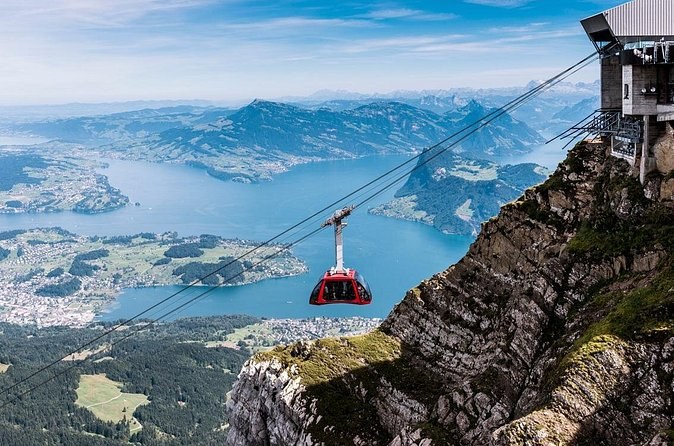
Mt Pilatus from Lucerne Including Boat Trip, Gondola, Cogwheel
The whole loop from Lucerne on one ticket, boat in second class, going either way round. Unguided; book a cogwheel seat to avoid a wait.
From $147 per person
Check Availability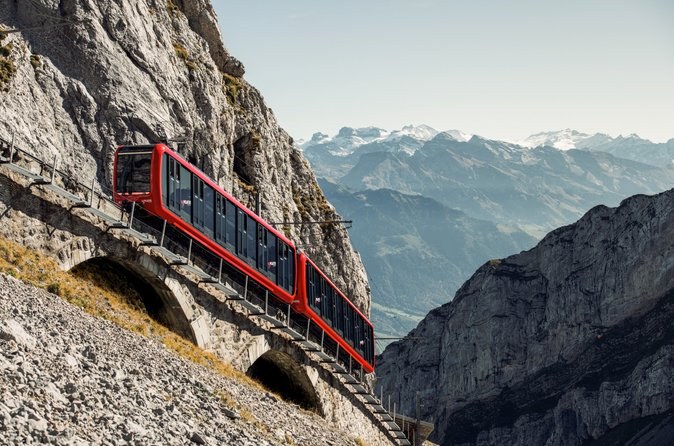
Mt. Pilatus Golden Roundtrip Small Group Day Tour from Basel
From Basel by InterCity train with an English-speaking guide: the whole loop, about three hours on the summit, and the cogwheel seat reserved for you.
From $568 per person
Check Availability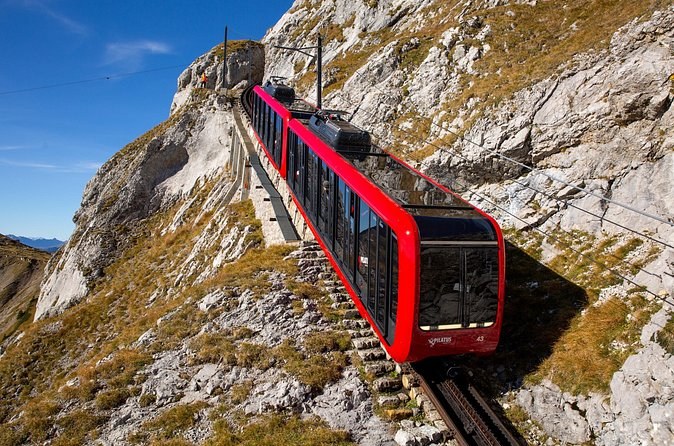
Mt Pilatus and Lucerne Day Trip from Zurich With Lake Cruise
From Sihlquai in Zurich: a drive past Lucerne's sights and free time in the old town, then the gondola, the cableway, the cogwheel and the lake, with a guide.
From $208 per person
Check AvailabilityNext: start with the cogwheel railway. Every guided day, private day and railway ticket up the mountain sits side by side on Mount Pilatus Tours.